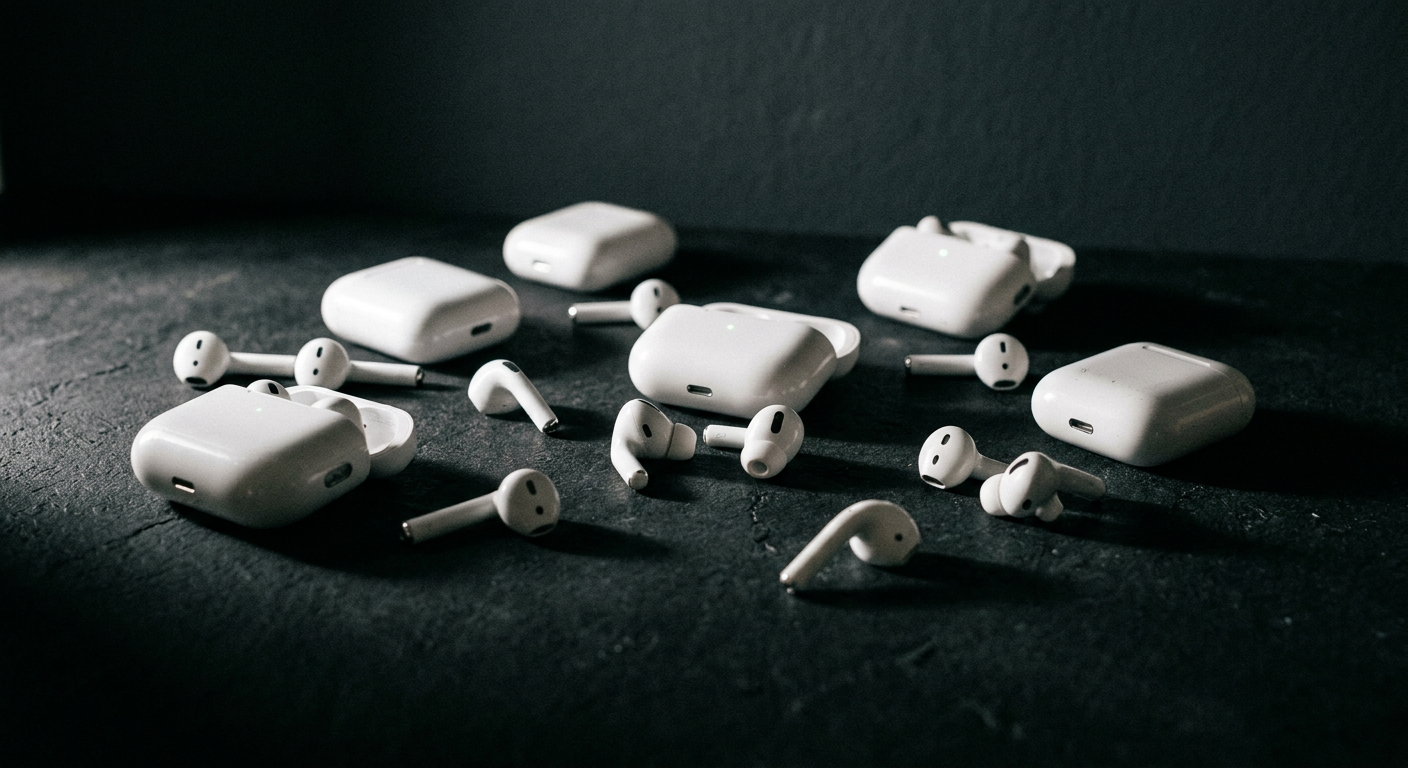
Apple's AirPods Empire Hits Peak Discount Season as Pro 3 Drop to $219 Just Five Months After Launch
Every model in Apple's headphone lineup is now on sale, with the five-month-old AirPods Pro 3 already discounted 12% and the flagship Max down $100. The unprecedented deals signal either oversupply or a new pricing strategy as Apple floods the market with options.
Apple's famously price-disciplined AirPods lineup is experiencing something unusual: simultaneous discounts across every single model, from the entry-level AirPods 4 at $89 to the flagship Max at $449. According to The Verge's latest deal roundup, the pattern suggests either Apple overestimated demand or is deliberately training consumers to expect lower prices — a risky move for a company that built its brand on premium pricing power.
The most striking example is the AirPods Pro 3, which launched just five months ago in September 2025 at Apple's "Awe Dropping" event. They're already selling for $219 at Amazon, Walmart, and Target — $30 below their $249 retail price and a 12% discount that would have been unthinkable for previous-generation Pro models this early in their lifecycle. Even more surprising: in early February, they briefly hit $199, cheaper than their Black Friday and Cyber Monday prices. For a product that added a built-in heart rate sensor, live translation, improved noise cancellation, and a fifth ear tip size, the rapid price erosion is notable.
The discounting extends down the entire product stack. The AirPods 4, which come in both standard and noise-canceling variants, are currently $89 and $119 respectively — 32% and 34% off their launch prices of $129 and $179. During Black Friday, the standard model hit an all-time low of $74, though it has since rebounded. Both versions launched in late 2024 as significant upgrades over the third-generation AirPods, featuring redesigned ergonomics, improved audio, and Apple's Voice Isolation technology for clearer calls in noisy environments.
The noise-canceling AirPods 4 are particularly interesting as a product positioning experiment. At $179 retail (now $119 on sale), they offer "surprisingly effective" noise cancellation, transparency mode, wireless charging, and a Find My-enabled speaker case — features previously reserved for the Pro line. The Verge notes they don't match the Pro 3's noise-canceling performance, but they're close enough to create an awkward overlap in Apple's own lineup. When the Pro 3 drops to $199 and the ANC-equipped AirPods 4 sit at $119, the $80 gap starts to look like a strategic miscalculation rather than deliberate tiering.
At the top end, the AirPods Max — Apple's aluminum-and-steel over-ear headphones — are down to $449 at Amazon, an $100 discount from their $549 retail price. These are the USB-C models that replaced the Lightning-equipped originals in late 2024, adding new color options but little else. The Verge describes them as "large and luxurious" with "excellent noise cancellation" and "expansive, balanced sound," though they lag competitors in bass response and features. More damning: "They're not the best noise-canceling headphones for most people — blame the sticker price." The Max have previously hit $399, suggesting there's room for even steeper cuts if inventory doesn't move.
What's driving this across-the-board discounting? Apple doesn't break out AirPods sales separately, but the company has been flooding the market with options — two versions of the AirPods 4, the Pro 3, the Max, and lingering inventory of older models. That's a lot of SKUs competing for the same ear canals, especially in a consumer electronics market that's shown signs of fatigue after the pandemic spending boom. The fact that the Pro 3 are already being discounted more aggressively than during the holiday shopping season suggests either production volumes outpaced demand or Apple is using promotions to maintain market share against competitors like Sony, Bose, and Samsung.
There's also a strategic risk here. Apple has spent two decades training consumers to expect that its products hold their value — iPhones, MacBooks, and yes, AirPods rarely see meaningful discounts outside of carrier subsidies or Black Friday. When the newest Pro model drops 20% in price just five months after launch, it signals to potential buyers that waiting pays off. Why buy at $249 in September when February brings $199? That's a dangerous precedent for a company whose entire business model depends on premium pricing and the perception of scarcity.
The deals are real and available now across Amazon, Walmart, Target, Best Buy, and Costco. For consumers, it's an excellent time to buy — every model in the AirPods lineup is discounted, and the Pro 3 at $219 represent genuine value given their feature set. But for Apple, the simultaneous markdown of its entire audio portfolio looks less like strategic pricing and more like an admission that it built too many headphones for a market that's not growing as fast as Cupertino hoped. The question is whether these discounts become the new normal or a temporary correction before Apple tightens supply and reasserts pricing discipline. Based on how quickly the Pro 3 have fallen, the former seems more likely.