China's Moon Rocket Suffers Landing Mishap in Test Flight as Space Race Intensifies
A Chinese lunar rocket test flight experienced an apparent landing failure despite the mission being deemed successful overall, underscoring the high-wire technical challenges facing space programs as multiple nations accelerate their return to the moon.
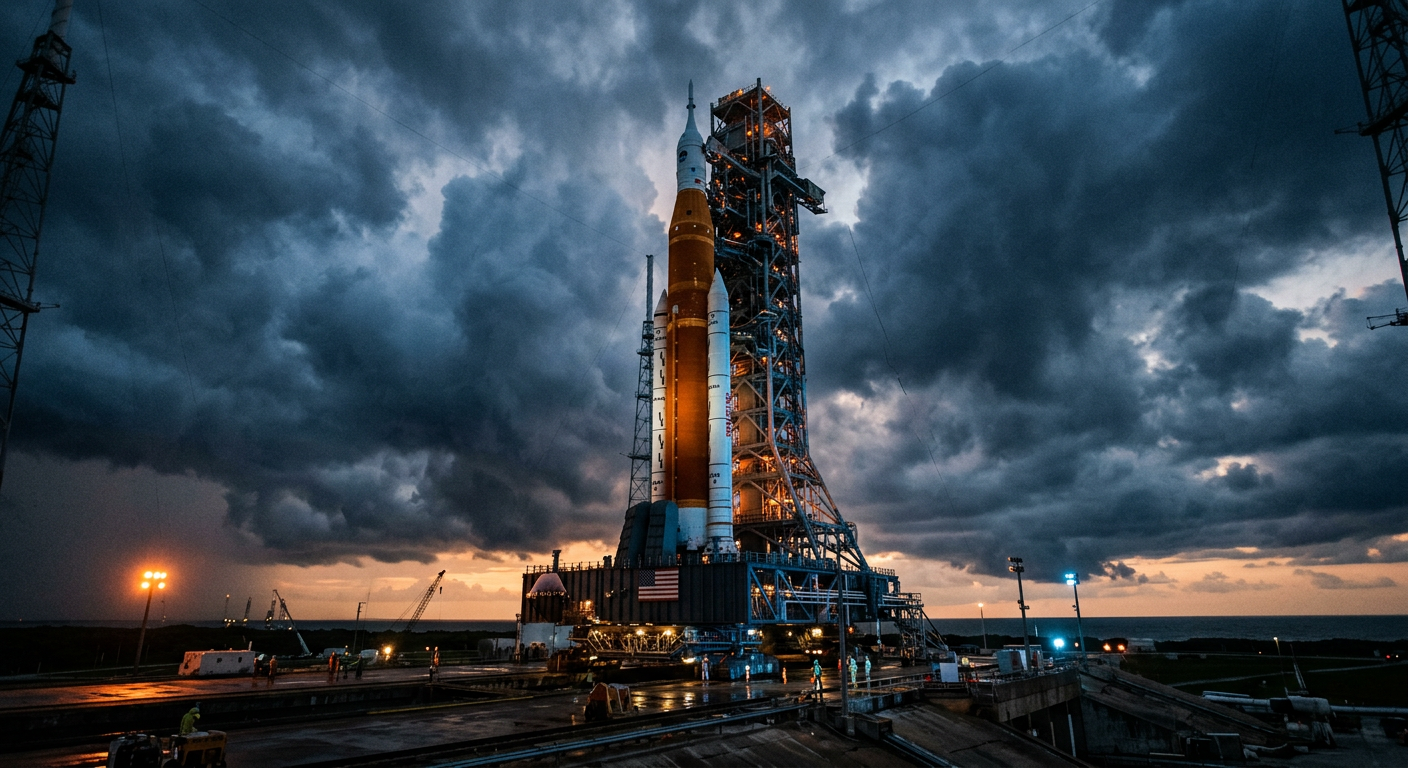
China's lunar ambitions hit a speed bump this week when one of its moon-bound rockets suffered what appears to be a landing anomaly during a test flight — though Chinese space officials are characterizing the mission as a success anyway, according to reports. The incident comes at a pivotal moment in the global space race, with NASA overhauling its troubled Artemis program and private companies like Rocket Lab and Firefly Aerospace ramping up launch cadences that would have seemed impossible just five years ago.
The details of China's rocket mishap remain murky, but the fact that officials are calling it a success despite visible problems speaks to how differently spacefaring nations calculate risk and communicate setbacks. This stands in stark contrast to NASA's approach with Artemis, where the agency recently announced it's fundamentally rethinking its timeline for returning humans to the lunar surface. A new analysis of solar superflares suggests Artemis 2 — the first crewed mission around the moon since 1972 — shouldn't launch until late 2026 at the earliest, according to Space.com. That's yet another delay for a program that has hemorrhaged credibility with each postponement.
The contrast is instructive. China operates under a veil of secrecy that allows it to frame technical failures as learning experiences without the political blowback NASA faces every time a heat shield test goes sideways or a rocket engine underperforms. But both approaches have costs: NASA's transparency invites scrutiny that can paralyze decision-making, while China's opacity makes it harder to assess whether their lunar program is genuinely on track or papering over deeper problems.
Meanwhile, the commercial space sector is lapping both superpowers. SpaceX wrapped up February with three Starlink launches in a single week, adding dozens more satellites to a constellation that now numbers nearly seven thousand, providing low-cost internet to remote corners of the globe. The company's Falcon 9 manifest for March alone includes at least six Starlink missions plus the EchoStar 25 broadcast satellite, a pace that would have been unthinkable in the Space Shuttle era. SpaceX has industrialized spaceflight in a way that makes government programs look like artisanal craftwork.
Firefly Aerospace, still recovering from explosive mishaps last year, is preparing its Alpha rocket for a critical seventh test flight dubbed "Stairway to Seven," now scheduled for no earlier than March 9 from Vandenberg Space Force Base in California. The mission was originally slated to carry a Lockheed Martin payload, but Firefly has repurposed it as a systems reverification flight with a demo payload — a pragmatic move that signals the company is taking reliability seriously after setbacks that could have killed a less well-capitalized startup.
Rocket Lab, the scrappy New Zealand-founded launcher, continues its own aggressive schedule with the "Insight at Speed is a Friend Indeed" mission set for March 5 and "Daughter Of The Stars" on March 23, both launching from the company's Mahia complex. Rocket Lab has quietly become one of the most reliable small-satellite launchers in the world, a reminder that the space industry's center of gravity has shifted from government agencies to nimble commercial operators who iterate faster and fail cheaper.
Europe, meanwhile, is trying to claw its way back into orbital relevance. Isar Aerospace's Spectrum rocket is scheduled for its second flight on March 19 from Andøya Spaceport in Norway — notable because it will be the first orbital launch from European soil in years, carrying cubesats from the European Space Agency's "Boost!" program. Europe's space ambitions have been hamstrung by bureaucratic sclerosis and a fragmented industrial base, but Isar represents a new generation of European launch startups trying to break the mold.
The broader picture is a space industry in violent transition. NASA's Artemis overhaul — details of which remain vague — suggests the agency knows its current architecture isn't sustainable. The program has been plagued by cost overruns, schedule slips, and questions about whether the Space Launch System rocket is worth its $4 billion per launch price tag when SpaceX's Starship promises to do the same job for a fraction of the cost. The solar superflare analysis gives NASA political cover to delay again, but it also highlights a genuine problem: long-duration missions beyond Earth's magnetic field expose astronauts to radiation risks we still don't fully understand.
China's willingness to push forward despite setbacks reflects a different calculus. The Chinese space program is less about scientific discovery than geopolitical prestige — planting a flag on the moon before America returns is worth taking risks that NASA's risk-averse culture won't tolerate. But that approach has limits. If China's lunar lander crashes on live television, no amount of propaganda can spin it as a success.
For skywatchers, March offers a consolation prize: a mini "planetary parade" is visible this week, with multiple planets aligning in the night sky in a relatively rare configuration. A total lunar eclipse is also on the calendar for March 2026, though that's still a year away. These celestial events remind us that while humans squabble over who gets to the moon first, the cosmos operates on timescales that make our ambitions look quaint.
The real story isn't which nation wins the new space race — it's that the race itself has been privatized. SpaceX, Rocket Lab, and Firefly are building the infrastructure that will make lunar missions routine, whether NASA, China, or someone else is writing the checks. The next decade will determine whether space remains a domain of national prestige or becomes just another industry where the best technology wins, regardless of the flag on the rocket. Based on current trends, bet on the latter.