Russia Poised for Oil Windfall as Middle East War Chokes 25% of Global Supply
The Iran conflict has effectively halted tanker traffic through the Strait of Hormuz, pushing Brent crude above $80 and creating an economic lifeline for Russia's war machine just as sanctions began to bite. Moscow stands to benefit from surging demand as India and China scramble for alternative suppliers.
The widening Middle East war has handed Vladimir Putin an unexpected reprieve. Just as Western sanctions were finally squeezing Russia's oil revenues to a five-year low, the conflict has choked off roughly a quarter of the world's seaborne oil trade and sent prices soaring — potentially flooding Moscow's coffers with billions in fresh revenue to fund its war in Ukraine.
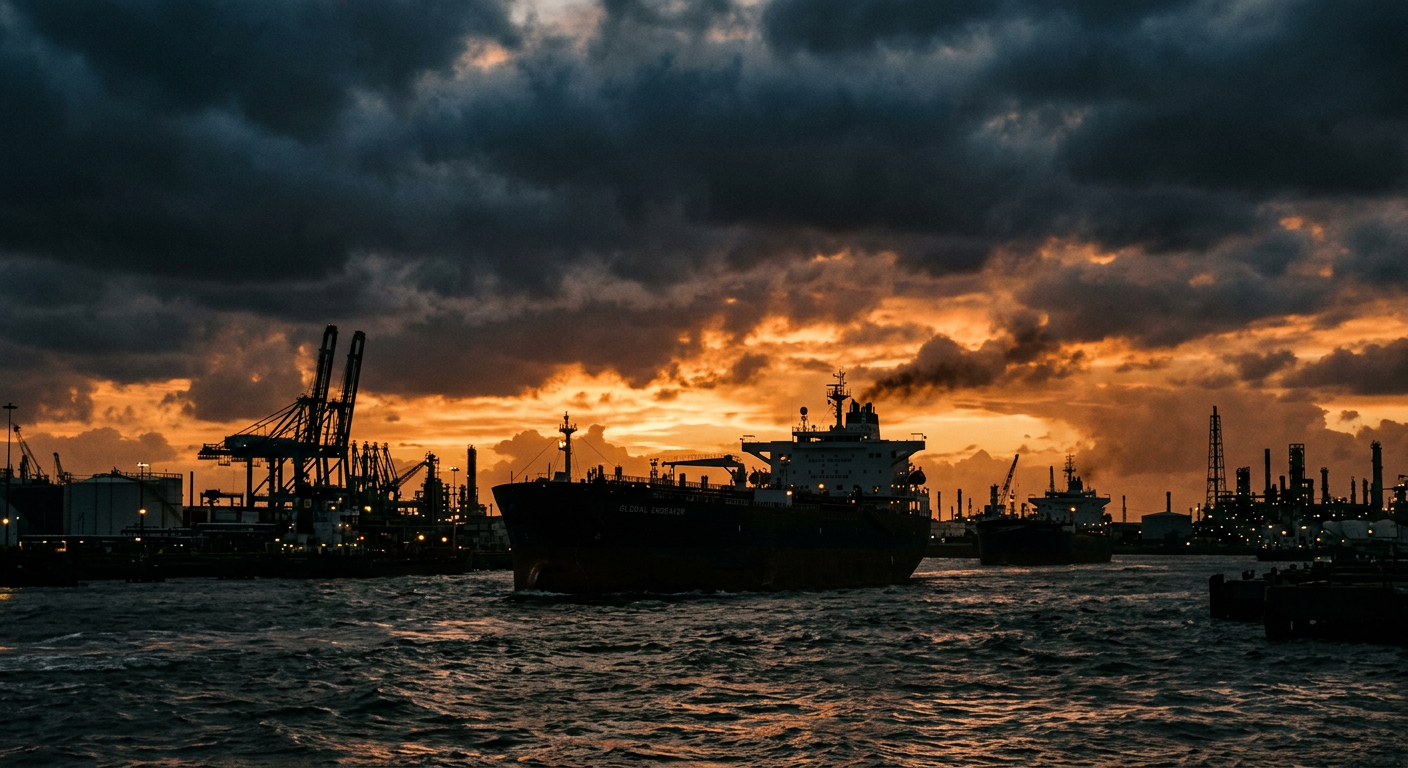
Brent crude rose 1.6% to $82.76 a barrel on Wednesday, according to CNBC, hovering near its highest level since January 2025 after jumping more than 7% earlier in the week. The surge followed U.S. and Israeli strikes on Iran over the weekend that killed Supreme Leader Ali Hosseini Khamenei, prompting Tehran to launch missile attacks across multiple Gulf nations. Tanker traffic through the Strait of Hormuz — the world's most critical oil chokepoint — has effectively stalled as vessels avoid the waterway for fear of Iranian attacks.
For Russia, the timing could scarcely be better. "When a good fifth of global oil supply and roughly a quarter of seaborne trade is effectively locked up, that's a boon for Russia," Sergey Vakulenko, a senior fellow at Carnegie Russia Eurasia Centre, told the Guardian. Moscow had been forced to offer steep discounts on its oil for months as a global supply glut and lingering sanctions made traders wary of Russian barrels. Storage capacity was tightening, and there were growing signs Russia might eventually be forced to curb production as cargoes struggled to find buyers.
Now, with Middle Eastern supplies locked behind a war zone, those Russian barrels sitting on tankers will "definitely find buyers," Vakulenko said. India and China — the largest buyers of Middle Eastern crude — are the most exposed. Most oil shipped through the Strait of Hormuz flows to China, India, Japan, and South Korea, according to the U.S. Energy Information Administration cited by CNBC. Under a scenario of a six-week closure and oil prices jumping from $70 to $85 a barrel, regional inflation in Asia could rise by about 0.7 percentage points, Goldman Sachs estimates.
India faces a particularly delicate calculus. Until recently, Russia was its largest crude supplier, but under a trade deal struck with Donald Trump last month, New Delhi began replacing some Russian cargoes with Gulf oil, cutting imports from Moscow to their lowest level since 2022. Should Middle Eastern supplies falter, Indian officials are likely to seek greater flexibility from Washington — reopening the door to increased Russian purchases, the Guardian reported. China, meanwhile, has long diversified its imports, but any sustained disruption to Gulf supplies could accelerate a deeper tilt toward Russian oil.
The irony is brutal: Trump's Iran offensive may inadvertently undermine his own administration's Ukraine strategy. For months, the UK, EU, and other allies have continued tightening sanctions against Russia, targeting its defense industry, shadow fleet, and energy revenues. According to the House of Commons Library, the UK has sanctioned 3,280 individuals, entities, and ships under its Russia regime, while the EU has sanctioned over 2,700 individuals and entities and 597 shadow fleet vessels. The UK government estimates that sanctions have denied Russia access to at least $450 billion since February 2022, including $285 billion in immobilized Russian Central Bank reserves held within EU and G7 countries.
But those efforts are now at risk of unraveling. Russia's oil and gas revenues fell to a five-year low in 2025 as crude prices softened and exports declined under sanctions — raising hopes in Kyiv that Moscow might struggle to sustain its military campaign into 2026. The Middle East war has reversed that trajectory overnight. "For our budget, the attack on Iran is a big plus," Kremlin TV host Vladimir Solovyov gloated to viewers on Monday, according to the Guardian. "If Trump strikes Iranian oilfields, then, as unfortunate as it sounds, we would become one of the few remaining oil-producing countries."
Russian energy stocks have already reacted, with Gazprom and Novatek among the main gainers on the Moscow exchange. Bank of America warns that a prolonged disruption in the Strait could push Brent above $100 per barrel and European natural gas prices above 60 euros ($70.17) per megawatt hour — a worst-case scenario that would dramatically boost Russian revenues.
The Trump administration has been notably absent from the sanctions coordination effort. In the first nine months of office, Trump did not join the UK, EU, and other allies in imposing any new sanctions on Russia, nor did he add any new individuals or entities to the Russia sanctions list, according to the House of Commons Library. In July, the U.S. also did not support lowering the Oil Price Cap, which aims to limit Russian energy revenues funding the Ukraine conflict.
Trump has instead favored imposing secondary sanctions on countries that continue trading with Russia, specifically those purchasing Russian oil. But at the time of writing, India is the only country subject to this additional tariff, despite China being the largest importer of Russian oil globally. In September, Trump announced the U.S. was ready to impose "major sanctions" on Russia — but only when NATO member states stop buying Russian oil. It wasn't until October that the U.S. finally imposed direct sanctions on Russia's two largest oil companies, Rosneft and Lukoil, coinciding with the cancellation of further peace talks with Putin.
The energy shock is now creating a fresh headache for central banks worldwide. Higher energy prices will filter through to consumer and producer prices, particularly for economies that rely heavily on Middle East oil imports, CNBC reported. The European Central Bank faces what ING economists called a "genuine dilemma" — an oil shock could push already sticky inflation higher while growth weakens under the strain of higher U.S. tariffs. Former Treasury Secretary Janet Yellen warned that the conflict could hit U.S. economic growth and fuel inflationary pressures, holding the Federal Reserve back from cutting rates. "The recent Iran situation puts the Fed even more on hold, more reluctant to cut rates than they were before this happened," Yellen said Monday.
Asian economies are particularly exposed. BMI, a unit of Fitch Solutions, estimates the conflict will add seven to 27 basis points to headline consumer inflation across Asia, with the sharpest impact in Thailand, South Korea, and Singapore. Nomura expects Malaysia, Australia, and Singapore to tighten interest rates, while rate cuts in the Philippines and Indonesia are likely on pause. "So which 'negative' do you want to have: higher inflation or worse fiscal?" Rob Subbaraman, head of global macro research at Nomura, asked on CNBC. "These are policy choices the governments have to make."
For Ukraine, the crisis risks more than just economic blowback. President Volodymyr Zelenskyy warned that Ukraine could face difficulties securing air defense systems, particularly U.S.-made Patriot missiles, if Washington and its regional allies prioritize their own needs. "We may have difficulties acquiring missiles and weapons to defend our airspace," Zelenskyy told Corriere della Sera, noting that Iran's strikes on Israel last June had already delayed some deliveries.
The prevailing mood in the Kremlin, according to a Moscow insider quoted by the Guardian, is one of "wait and see." "The world is in turmoil, but this time we're not at the epicentre," the source said. Putin has been careful not to criticize Trump too harshly over the bombing of Iran, wary of antagonizing a U.S. president he sees as pivotal in pressuring Ukraine to accept peace terms on Moscow's conditions. Instead, with every increase in oil prices, there is barely concealed satisfaction among Russia's elite. "$100+ oil per barrel soon," Kirill Dmitriev, head of Russia's sovereign wealth fund, wrote on X.
For Europe, the crisis risks reopening divisions over its approach toward Moscow. The EU has been moving to phase out Russian fossil fuels, a policy opposed by Hungary and Slovakia and criticized by surging rightwing parties across the bloc. Norway's energy minister, Terje Aasland, acknowledged on Tuesday that the escalation could revive debate within the EU over banning Russian gas imports. "With the geopolitical situation we see now, I believe the debate will be revived," Aasland told a conference in Oslo.
Much depends on how long the crisis lasts. Importing countries typically hold about three months' worth of oil in advance, and last summer's 12-day fighting had only a fleeting impact on energy markets. "If it's two weeks, it doesn't matter much. If it's longer, then things start to get interesting," Vakulenko said. But if Gulf energy infrastructure is severely damaged, the disruption could stretch well into 2026 — giving Putin exactly the economic cushion he needs to sustain his war machine through another grinding year of conflict. The West spent three years building a sanctions architecture to starve Russia of oil revenue. Trump's Iran gambit may have just torn a hole in it.