Turkey Shoots Down Iranian Missile as NATO Refuses Article 5 — and Russia's Medvedev Mocks Trump's 'Nobel Peace Prize'
A ballistic missile heading toward Turkish airspace was intercepted by NATO defenses Wednesday, but alliance chief Mark Rutte ruled out invoking collective defense — even as the Iran war spreads to Azerbaijan, Cyprus, and the Indian Ocean. Kremlin official Dmitry Medvedev seized the moment to mock Trump's peace prize ambitions.
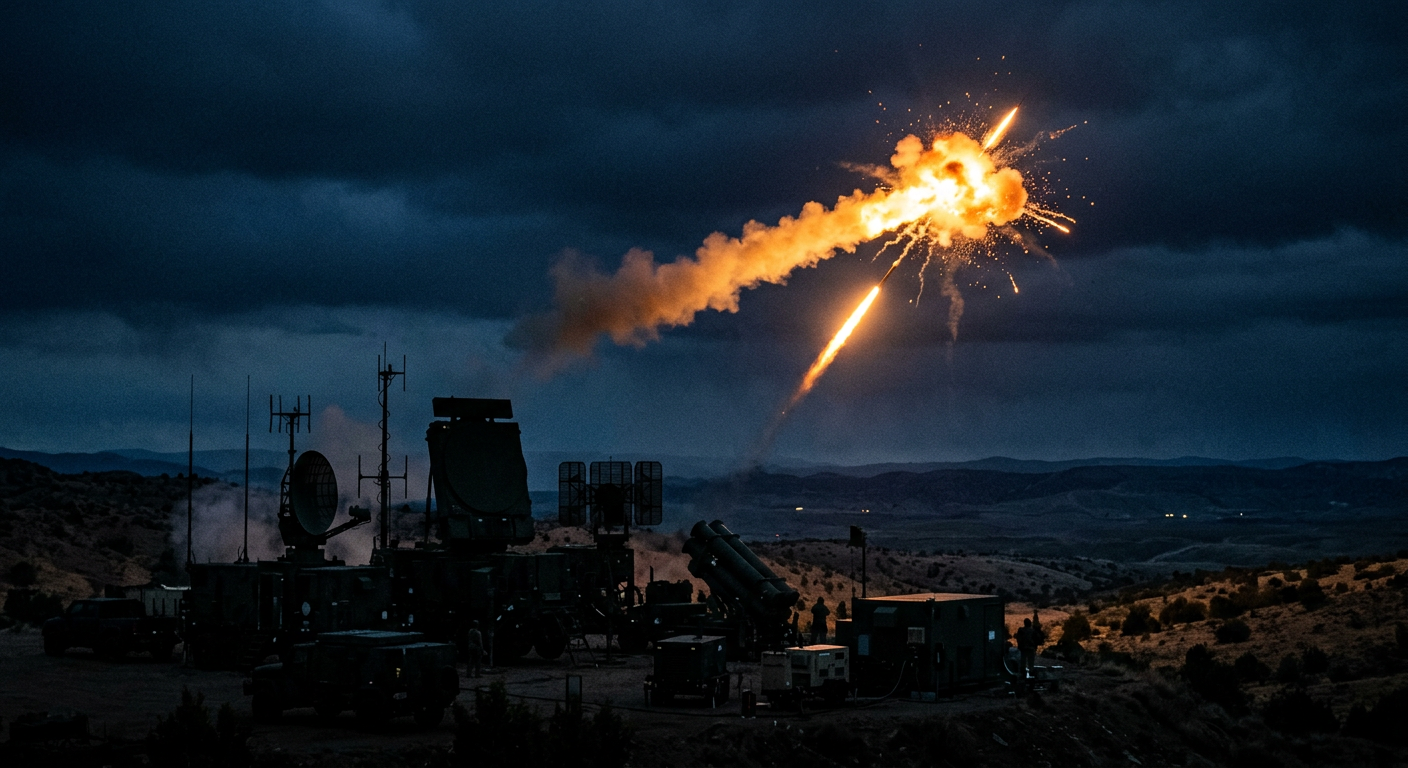
NATO air and missile defense systems shot down a ballistic missile heading toward Turkish airspace on Wednesday, marking the closest the Iran war has come to triggering the alliance's collective defense pact — and exposing the high bar for Western military action even as the conflict ricochets across continents.
Turkey, a NATO member since 1952, reported that debris from the intercepted missile fell in the southern Hatay province. Iran denied firing the weapon. But NATO Secretary General Mark Rutte called the incident "very important" and "clearly serious," telling Reuters it demonstrated "clear evidence" that the alliance "will defend every inch of NATO territory."
Then he shut the door on escalation. "Article 5 I think is not in order here, and nobody's talking about Article 5," Rutte said Thursday morning. The statement effectively ruled out NATO's mutual defense clause, which obliges all 32 members to treat an attack on one as an attack on all — the principle invoked only once in the alliance's history, after September 11, 2001.
The decision reflects NATO's careful balancing act as the U.S.-Israeli war against Iran expands beyond anyone's initial projections. Defense Secretary Pete Hegseth said Thursday that America is "accelerating, not decelerating" its operations, with more military assets flowing to the region. A U.S. torpedo sank the Iranian frigate IRIS Dena off Sri Lanka in the Indian Ocean — 2,000 miles from Iran's shores — killing nearly 130 sailors, according to Iran's foreign minister Abbas Araghchi, who warned that Washington "will come to bitterly regret the precedent it has set."
The war's geographic sprawl now stretches from the Persian Gulf to the Caucasus. Azerbaijan summoned Iran's ambassador Thursday after two Iranian drones crashed on its territory, one damaging Nakhchivan Airport's terminal and another striking near a school in Shekarabad village, injuring two civilians. Baku called the incidents "drone attacks" and reserved "the right to take appropriate retaliatory measures," according to its foreign ministry.
Iran has struck the UAE, Bahrain, Oman, Kuwait, Iraq, and Saudi Arabia in recent days. Shahed-like drones — the one-way attack weapons Iran manufactures and exports to Russia — targeted a British airbase in Cyprus this week, though the U.K. defense ministry said the drones were not launched from Iranian territory. According to Euronews, NATO held no discussions about the Cyprus attacks, deeming them too minor to warrant alliance-level talks. CNBC reported that six U.S. troops have been killed since the war began, including five soldiers and one chief warrant officer who died in an unmanned aircraft attack at Port Shuaiba, Kuwait.
The incidents reveal what Hamish Kinnear, senior Middle East and North Africa analyst at Verisk Maplecroft, called Iran's "willingness to widen what it sees as an existential war of survival." Speaking to CNBC, Kinnear said attacks on Turkey and British bases "raised the stakes further for an expanding regional war, even if it is unclear that Iran was deliberately aiming at Turkey." If Tehran escalates against Turkey, he predicted it would likely target U.S. military installations and energy infrastructure — mirroring Iranian tactics in the Persian Gulf.
For NATO, the Turkey missile incident poses an uncomfortable question: what constitutes an attack serious enough to invoke Article 5? The alliance has already declined to trigger collective defense over Russian drones entering Polish airspace in September 2025, instead launching Operation Eastern Sentry to bolster air defenses. NATO called its commitment to Article 5 "ironclad" but said it would "respond in the manner, timing, and domain of our choosing" — diplomatic language for: we'll decide what counts as war.
Guntram Wolff, senior fellow at the Brussels-based think tank Bruegel, told CNBC that triggering Article 5 "would be a little bit exaggerated" over a single intercepted missile. But he warned of a darker scenario: "prolonged instability in Iran itself with then implications for regional stability." Wolff compared it to Yemen's Houthi rebels launching sporadic rocket attacks — "this kind of instability would be really bad for the entire region."
Russia, predictably, is enjoying NATO's discomfort. Dmitry Medvedev, deputy chairman of Russia's Security Council and a close ally of Vladimir Putin, unleashed a mocking tirade on social media Thursday. "NATO's nuts!" Medvedev wrote. "First, the US kills Iran's leader and starts a war in the Middle East. Next, NATO idiots led by Trump's servile 'sonny' Rutte mull invoking Article 5. How about nominating POTUS for the Nobel Peace Prize for starting a major war, eh? Orwell was right: war is peace!"
Medvedev's jab at Trump's Nobel ambitions underscores the Kremlin's broader strategy: paint the U.S. as a chaos agent while Russia positions itself as a voice for diplomatic restraint. Moscow has sharply criticized the U.S.-Israeli strikes and called for renewed nuclear talks, even as it supplies Iran with military technology and intelligence. Russia accuses NATO's European members of seeking to "prolong the Ukraine war and damage Russia for their own strategic advantage" — a claim that rings hollow given Russia's full-scale invasion now entering its fifth year.
NATO allies are walking a tightrope. The U.K. and France sent warships to the Middle East and pledged to defend regional partners from Iranian attacks, but they've declined direct involvement in the U.S.-Israeli campaign. European members have already depleted military stockpiles supporting Ukraine, and pledges to boost defense spending have stalled. The alliance is fighting a two-front information war: deterring Russia in Eastern Europe while avoiding entanglement in a Middle Eastern conflict that could spiral into a generational quagmire.
Israeli officials told CBS News that intelligence indicated Iran was within two weeks of enriching uranium to 90% — weapons-grade material — before the strikes began, though Iran's weaponization program was "still far from producing a classic nuclear bomb." Israel has stepped up strikes in Tehran and Lebanon, and Lebanese state media reported that an Israeli drone killed Hamas official Wassim Atallah al-Ali and his wife in a pre-dawn strike on a Palestinian refugee camp near Tripoli — the first targeted killing of a Hamas member since the war began.
The Iranian regime postponed Ayatollah Ali Khamenei's three-day funeral amid the escalating violence. A U.S.-based monitoring organization estimates that more than 1,000 civilians have been killed in Iran, including over 180 children, according to CBS News. Iran's Revolutionary Guard claimed it struck a U.S. oil tanker in the Persian Gulf, but maritime security agencies debunked the claim — the missile actually hit the Bahamas-flagged Sonangol Namibe off Kuwait, causing an oil leak.
NATO's refusal to invoke Article 5 over the Turkey incident sends a clear signal: the alliance will defend its territory with air defenses and strongly worded condemnations, but it will not be dragged into a shooting war with Iran unless the attacks become undeniable and sustained. That's a rational calculation given NATO's Ukraine commitments and the risk of a two-theater war. But it also reveals the limits of collective defense in an era of drones, proxy forces, and plausible deniability.
For Trump, the optics are brutal. He launched a war to prevent Iran from obtaining nuclear weapons, but five days in, the conflict has killed American troops, sunk an Iranian warship, and brought NATO allies under fire — while Russia mocks his Nobel Prize dreams and the alliance he claims to lead refuses to back his play. Rutte's careful parsing of what does and doesn't constitute an Article 5 trigger suggests NATO is already planning for a long, messy war where the U.S. fights largely alone.
The real danger, as Wolff noted, isn't a single missile or drone strike. It's the grinding instability that follows regime collapse — factional warfare, refugee flows, and opportunistic attacks by militias with nothing to lose. NATO has decided that defending Turkish airspace is worth a missile battery, but not worth a war. Whether that calculation holds as the body count rises and the conflict metastasizes remains the open question of 2026.