SpaceX's Falcon 9 Booster Flies 25th Mission as Starlink Constellation Nears 10,000 Satellites
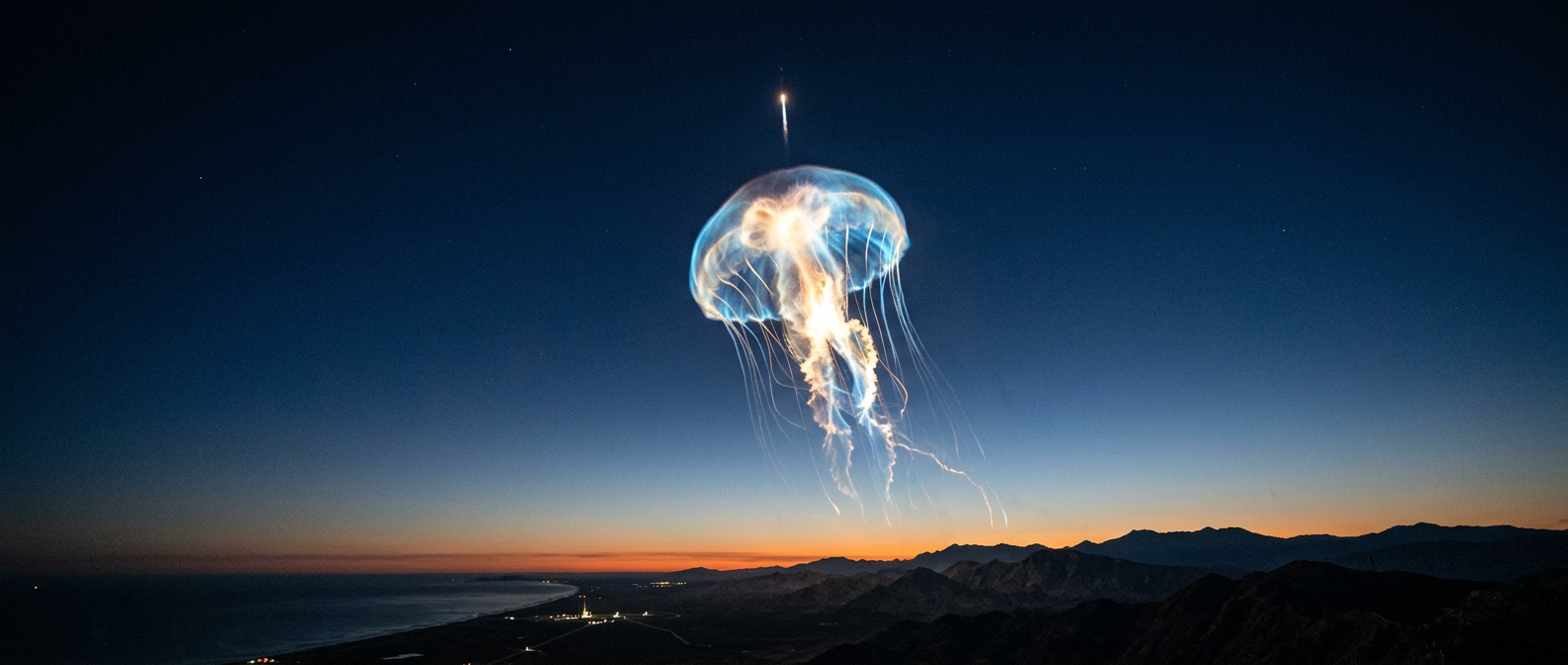
A SpaceX Falcon 9 first-stage booster completed a record-tying 25th flight on March 4, deploying 29 Starlink satellites and marking the company's 580th successful landing. The predawn launch created a spectacular 'jellyfish' effect over Florida as SpaceX closes in on 10,000 active satellites in orbit.
SpaceX marked another milestone in reusable rocketry this morning when Falcon 9 Booster 1080 completed its 25th flight to space and back — a feat that underscores just how routine the once-impossible has become. The 5:52 a.m. EST launch from Cape Canaveral Space Force Station's Space Launch Complex 40 deployed 29 Starlink satellites into low Earth orbit, pushing the company's megaconstellation to within striking distance of 10,000 active units, according to Space.com.
The booster, which first flew in May 2023 on the Axiom-2 private astronaut mission, landed successfully on the droneship "A Shortfall of Gravitas" stationed in the Atlantic Ocean — SpaceX's 580th landing in company history. It's a number that would have seemed absurd a decade ago, when the idea of landing an orbital-class rocket was still considered science fiction by much of the aerospace establishment.
But the real spectacle came not from the engineering achievement itself, but from what early risers across Florida witnessed in the predawn sky. As the Falcon 9's upper stage climbed through the atmosphere, sunlight — still below the horizon for ground observers — illuminated the rocket's exhaust plume, creating what's colloquially known as a "space jellyfish." The effect, caused by water vapor and carbon dioxide in the exhaust catching the sun's rays against a still-dark sky, produced a translucent, bulbous cloud that SpaceX captured in time-lapse photography. These dawn and dusk launches have become social media phenomena, turning what is now a twice-weekly occurrence into a recurring public art installation.
This was SpaceX's 28th launch of 2026, and 23 of those missions have been dedicated to building out Starlink — a ratio that tells you everything about where SpaceX's business priorities lie. The company is no longer just a launch provider; it's become a satellite operator at a scale never before attempted. With the Starlink constellation approaching 10,000 satellites, SpaceX has deployed more spacecraft than the rest of the world combined over the past several years.
The pace is staggering. According to Wikipedia's comprehensive tracking of Falcon launches, the Falcon 9 family has now flown 621 times since June 2010, with 618 full mission successes — a 99.52% success rate. The active Block 5 variant, introduced in May 2018, has achieved 553 successful flights out of 554 attempts, a 99.82% success rate that would be remarkable for any rocket, let alone one attempting powered landings after each mission.
In 2024, SpaceX launched 134 Falcon missions, accounting for more than half of all orbital launches worldwide that year. The company broke the Soviet Union's 1980 record of 63 R-7 family launches, and then kept going. Reusability has fundamentally altered the economics of spaceflight: the first stage constitutes the majority of a new rocket's cost, and SpaceX has now successfully landed 580 boosters in 593 attempts — a 97.8% success rate.
Booster 1080's 25th flight ties it near the top of SpaceX's reuse leaderboard, though it still trails the current champion, B1067, which has flown 33 missions. SpaceX has reflown 53 different boosters multiple times, and has even begun reusing fairing halves more than 300 times — with fairing serial number SN185 having flown 36 times, making it the second-most reflown rocket component to reach space.
For residents near Vandenberg Space Force Base in California, another Starlink launch is on the horizon. According to the Ventura County Star, SpaceX is targeting Saturday, March 7, for a launch of 25 more Starlink satellites aboard a Falcon 9, with a four-hour window opening at 2:58 a.m. PT. That mission will fly a southern trajectory from Space Launch Complex 4E, visible from viewing spots across Santa Barbara, Ventura, and San Luis Obispo counties — assuming weather cooperates and the rocket doesn't scrub.
The Vandenberg launch site, while closed to the public, has become a regular fixture in California's coastal communities. Popular viewing locations include Ocean Park in Lompoc, just four miles from the pad, and Surf Beach, where spectators gather despite having to cross active Amtrak tracks. The tourism bureaus in Ventura and San Luis Obispo counties now maintain official lists of recommended viewing sites, treating rocket launches as a regional attraction — which, in 2026, they very much are.
What's striking about this moment is how unremarkable it's becoming. A booster flying its 25th mission, landing on a drone ship, deploying satellites into a constellation nearing 10,000 units — these are the metrics of an industrial operation, not a moonshot. SpaceX has moved from proving reusability works to optimizing it at scale, refining turnaround times and refurbishment processes with each flight. The company's 2026 launch manifest is dominated by Starlink missions because the business case has closed: SpaceX can launch its own satellites cheaper than anyone else can, and it's using that advantage to build a global internet service projected to generate tens of billions in annual revenue.
The geopolitical implications are harder to ignore with each launch. SpaceX's launch cadence now exceeds that of entire nations, and its satellite constellation provides communications infrastructure that governments and militaries increasingly rely upon. When a single company can deploy more spacecraft in a year than the rest of the world combined, the balance of power in space shifts in ways that policymakers are still struggling to understand.
For now, the spectacle continues. Booster 1080 will be refurbished and fly again, likely within weeks. The Starlink constellation will continue growing. And somewhere over Florida or California, another predawn launch will paint another jellyfish across the sky, a fleeting reminder that the future arrived faster than most of us realized.