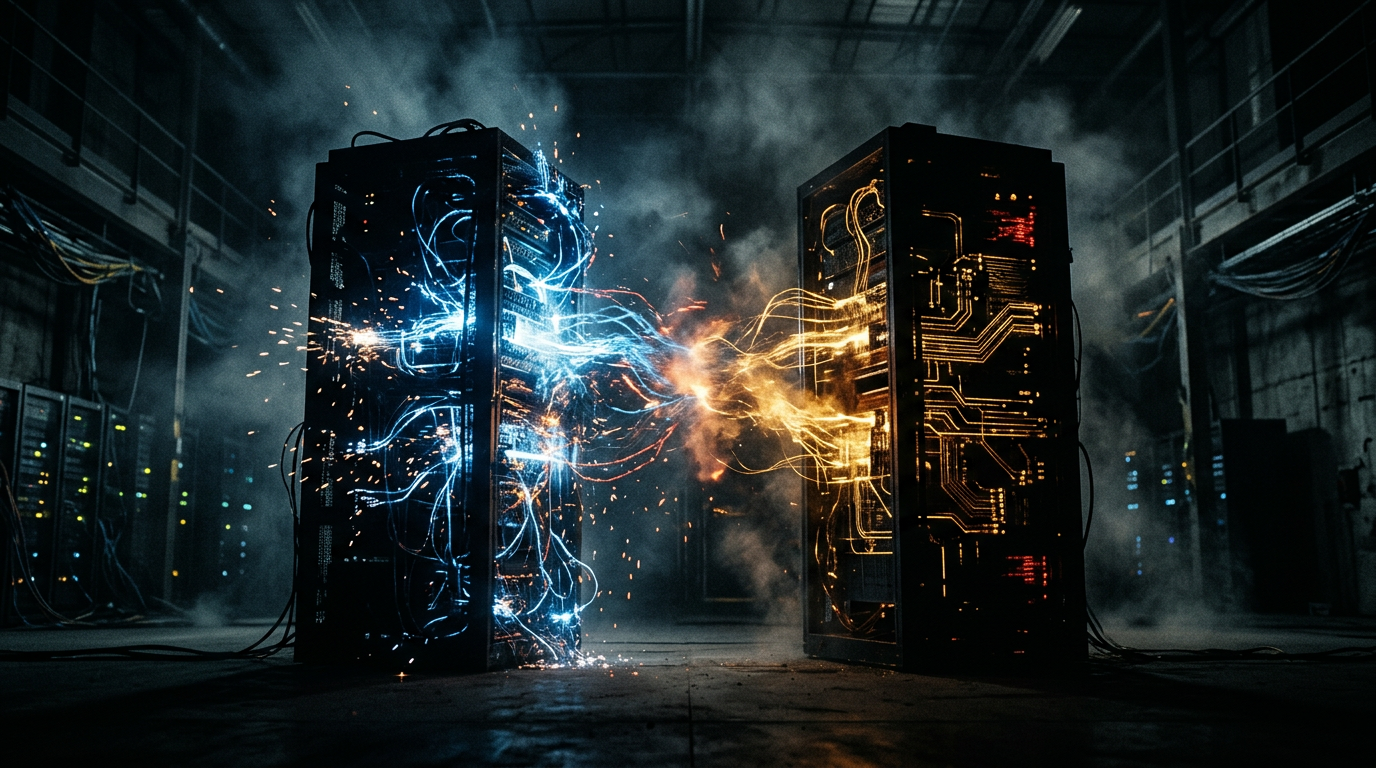
The AI Rivalry OpenAI Couldn't Predict
When Sam Altman built OpenAI into the world's most valuable AI startup, he didn't count on his biggest threat coming from a former safety researcher with a contrarian vision. Anthropic's rise reveals what happens when ideology meets market reality.
Sam Altman has spent the past two years convincing the world that OpenAI is the inevitable winner of the artificial intelligence race. He's raised billions from Microsoft, launched ChatGPT to 100 million users in record time, and positioned his company as the singular force that will shape humanity's AI future. But there's a problem with inevitability narratives: they tend to ignore the people who refuse to accept them.
Dario Amodei didn't just refuse. He left OpenAI in 2021, took a cohort of the company's top safety researchers with him, and built Anthropic into what has become OpenAI's most formidable competitor. Not through flashier products or faster models, but through a fundamentally different bet about what the AI market actually wants. While Altman races toward artificial general intelligence with the fervor of a prophet, Amodei is selling something more prosaic and potentially more valuable: trustworthy AI that enterprises will actually deploy.
The divergence between these two companies tells us more about the future of AI than any benchmark or research paper. OpenAI operates on the assumption that capability is everything—that if you build the most powerful model, customers will figure out how to use it. Anthropic's Claude, by contrast, is designed around constitutional AI principles that prioritize reliability and safety from the ground up. It's not just a technical difference; it's a philosophical one about whether AI companies are building tools or building gods.
And here's what OpenAI didn't see coming: the enterprise market doesn't want gods. It wants dependable systems that won't hallucinate customer data, leak proprietary information, or generate liability-creating content. Anthropic has signed deals with Salesforce, Notion, DuckDuckGo, and most tellingly, attracted a $4 billion investment from Amazon. These aren't companies gambling on AGI arriving next year. They're companies that need AI they can actually integrate into products today.
The contrast became stark when OpenAI launched GPT-4 with maximum hype and minimal transparency about its training data, safety testing, or limitations. Anthropic responded by publishing detailed constitutional AI papers, offering clearer usage policies, and emphasizing interpretability research. One approach generates headlines; the other generates enterprise contracts. Guess which one has better margins?
This isn't to say Anthropic has won or that OpenAI is failing—far from it. OpenAI still has the brand recognition, the Microsoft partnership, and the raw talent to dominate consumer AI. But Amodei identified something Altman overlooked: there's a massive market for companies that want AI without the existential baggage. Every Fortune 500 CISO who's read about ChatGPT leaking Samsung's semiconductor designs is a potential Anthropic customer.
The irony is rich. Amodei left OpenAI partly over concerns that the company was prioritizing speed over safety, that the shift from nonprofit to capped-profit had changed its incentives. Now he's built a company that's arguably more commercially successful precisely because it takes safety seriously. Turns out the market values guardrails more than OpenAI's leadership assumed.
What we're watching is the maturation of an industry in real-time. The early phase of any transformative technology is dominated by those who promise revolution. But the real money—the sustainable, decade-long money—goes to those who deliver evolution. Anthropic understood this earlier than most. While OpenAI chases the headline-grabbing milestone of AGI, Anthropic is quietly becoming the AI provider that enterprises actually trust with their most sensitive workloads.
The competition between these companies will define not just which models win, but what kind of AI future we get. OpenAI's approach could give us breakthrough capabilities faster but with higher risks. Anthropic's path might be slower but more stable. The market is currently placing bets on both, which is probably wise. But if you're watching where the smart enterprise money is flowing, there's a clear pattern emerging.
Altman built OpenAI to change the world. Amodei might just change it first by being the one who made AI boring enough to trust. In technology, boring often wins.