The AI Revolution Hits a Speed Bump: When Communities Say No to Progress
As artificial intelligence reshapes everything from medical research to smart TVs, a New Jersey town's rejection of an AI data center reveals the growing friction between technological ambition and local reality. The future isn't just being built in labs—it's being negotiated at city council meetings.
There's a telling irony in this week's cascade of AI announcements. While researchers in Hawaii celebrate algorithms that obey the laws of physics, and YouTube experiments with conversational AI on your living room TV, a city council in New Jersey just reminded Silicon Valley of a law it can't code around: local zoning.
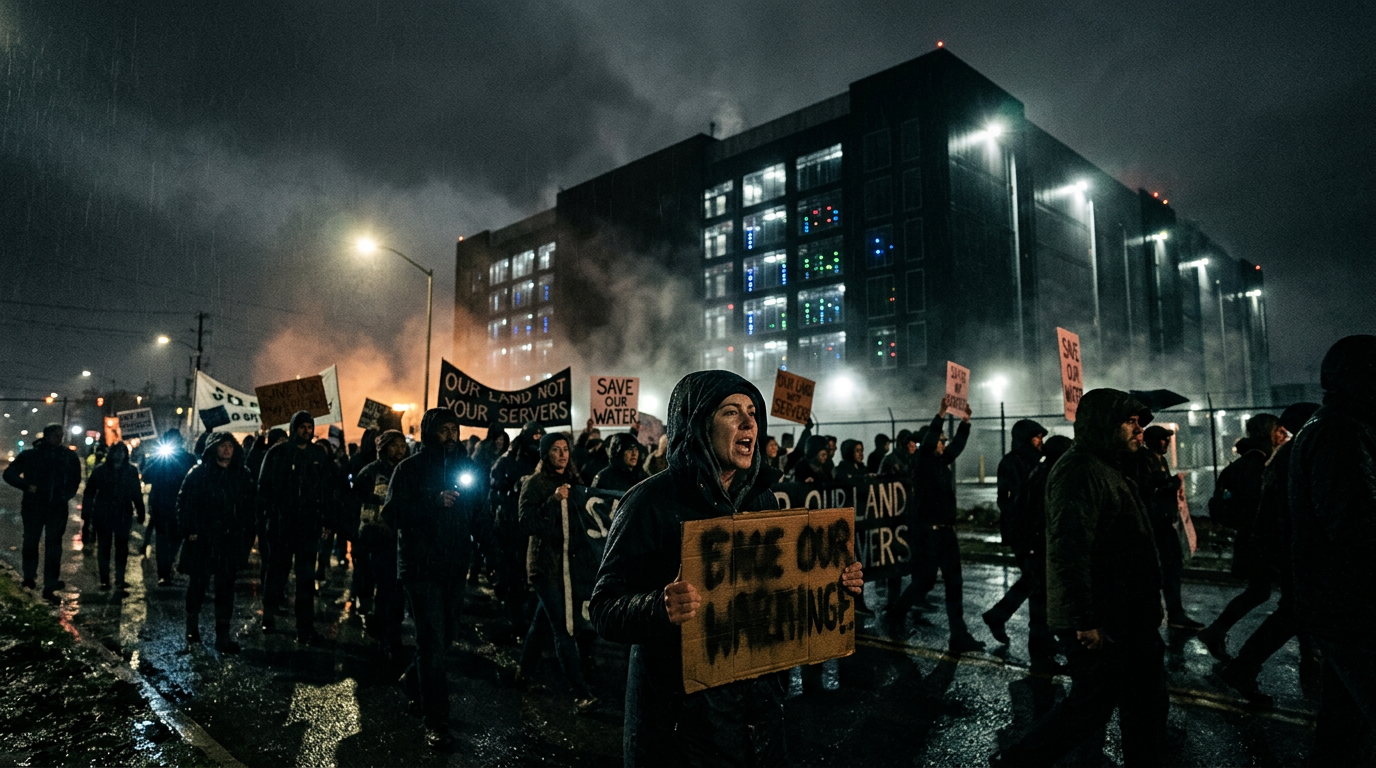
New Brunswick's rejection of a proposed AI data center at 100 Jersey Avenue marks a pivotal moment in the AI infrastructure buildout. The facility promised tax revenue and positioned itself as essential digital infrastructure. But residents saw something else entirely: a power-hungry behemoth that would strain the electrical grid, generate constant noise, and deliver almost no permanent jobs in return. The council sided with the community, and the project died.
This isn't just a NIMBY story. It's a preview of the friction that will define AI's next chapter. We've spent the past two years marveling at what large language models can do—write code, summarize videos, predict chemical reactions under planetary-core pressure. Now comes the reckoning: where does all this computation actually happen, and who pays the price?
The answer, increasingly, is nowhere near the people making the decisions. AI data centers are being pitched to mid-sized cities as economic development opportunities, but the math rarely works out for residents. These facilities consume electricity on an industrial scale—often equivalent to a small city—while employing skeleton crews of technicians. They're not factories. They don't create bustling supply chains or anchor neighborhoods. They're just extraordinarily expensive boxes that get very hot and require a lot of cooling.
The energy problem is real and worsening. As AI models grow more sophisticated, their appetite for compute grows exponentially. Training a single large model can consume as much electricity as several hundred American homes use in a year. Inference—actually running these models at scale—is even more demanding. YouTube's expansion of conversational AI to smart TVs sounds convenient until you consider that millions of households asking their television questions simultaneously creates a staggering new load on data infrastructure.
Meanwhile, the University of Hawaii's physics-informed algorithm breakthrough illustrates where AI is genuinely transformative. By ensuring that machine learning models respect fundamental physical laws, researchers have created tools that can simulate fluid dynamics and climate patterns with unprecedented accuracy. This isn't about making search results slightly better or generating another chatbot. It's about solving problems—renewable energy planning, weather prediction, engineering challenges—that directly affect human welfare.
The contrast is stark. On one hand, we have AI applications that clearly advance scientific understanding and could help address climate change. On the other, we're building energy-intensive infrastructure to power features like asking your TV to summarize a cooking video you're already watching.
Reddit's new AI shopping search feature falls somewhere in between. The platform has recognized that its greatest asset isn't its interface or its algorithm—it's the accumulated wisdom of millions of humans arguing about which vacuum cleaner actually works. Training an LLM to synthesize those arguments makes sense. But it also represents the latest enclosure of the digital commons: user-generated content, freely given, now processed and monetized through proprietary AI systems that those same users will likely need to pay to access in full.
The healthcare and education initiatives announced this week—Weill Cornell's AI to Advance Medicine program and UNT's new AI major—signal that institutions are taking the technology seriously as a career path and clinical tool. These are long-term investments in human capital and patient outcomes. They're also tacit admissions that AI isn't a plug-and-play solution. It requires specialized training, ethical frameworks, and clinical validation. The gap between a demo and a deployed system that doctors actually trust remains enormous.
India's Global AI Future Summit in New Delhi underscores the geopolitical dimension. As the world's most populous nation and a major tech hub, India is positioning itself as a bridge between Western AI developers and the Global South. The summit's focus on equitable distribution and AI safety reflects a growing awareness that the current trajectory—dominated by American and Chinese companies—may not serve the interests of the majority of humanity. Discussions about deepfakes and automated warfare aren't theoretical. These technologies are already being deployed, and the countries most vulnerable to their misuse often have the least say in how they're governed.
Which brings us back to New Brunswick. The city council's decision won't stop the AI boom, but it signals that communities are learning to ask harder questions. Who benefits? Who bears the costs? What are we actually getting in exchange for the electricity, the noise, the industrial footprint?
The AI industry has spent years insisting that its work is inevitable, that resistance is futile or Luddite. But infrastructure isn't inevitable—it's negotiated. Every data center requires permits, power contracts, community approval. Every breakthrough algorithm still needs to prove it's worth the resources it consumes. The New Brunswick vote is a reminder that progress isn't just a technical problem. It's a political one, decided not in boardrooms or research labs, but in municipal meetings where people ask the uncomfortable question: progress for whom?
The next phase of AI development will be shaped as much by these local battles as by any algorithmic breakthrough. Companies that treat communities as obstacles to route around will find themselves, increasingly, routed around. Those that can demonstrate genuine value—not just to shareholders, but to the people who live near their infrastructure—will earn the social license to build. The technology may be cutting-edge, but the politics are ancient: you want to build something big and loud in my neighborhood? Show me why I should say yes.