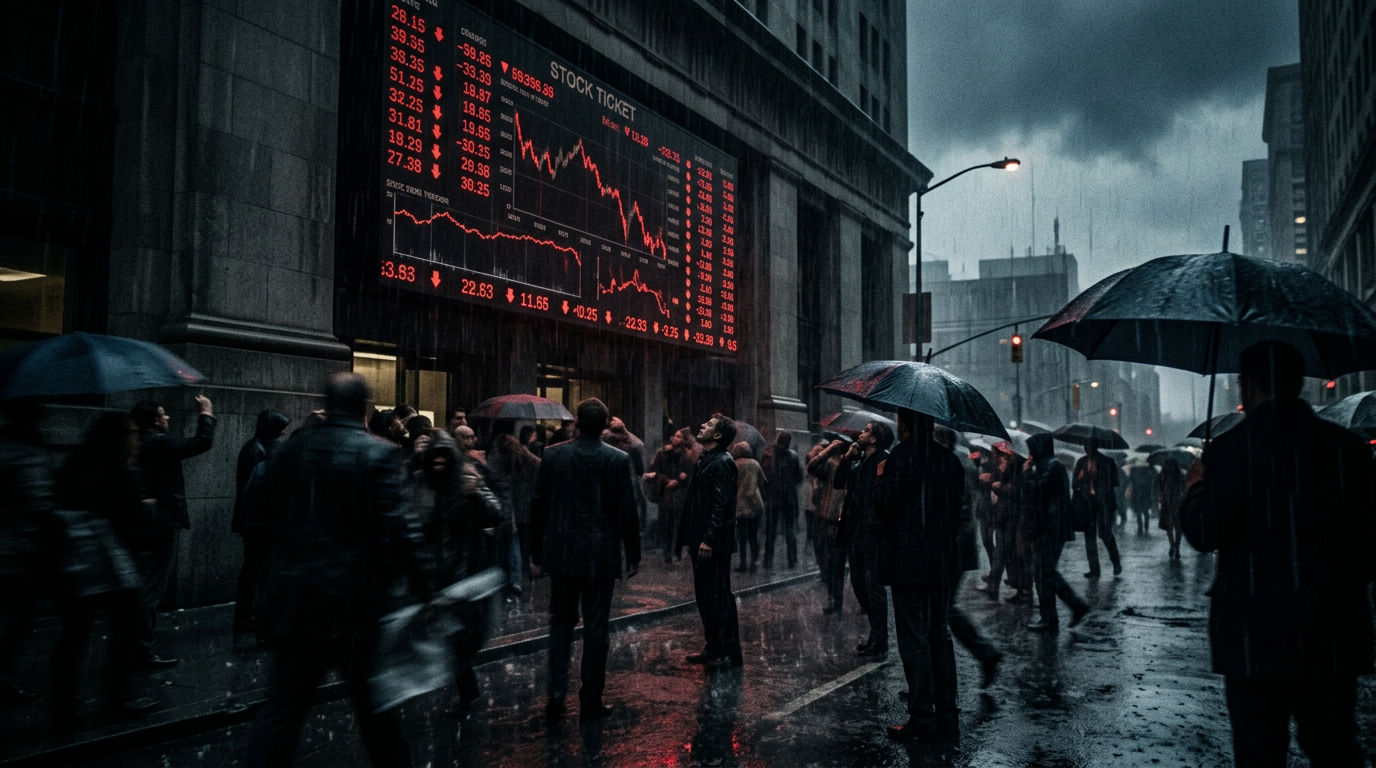
The Market's February Reckoning: When Everything Changed at Once
February delivered the worst month for stocks since March's banking crisis, while gold surged and oil spiked amid escalating conflict with Iran. But beneath the volatility lies a more fundamental shift: the end of the everything-rally and the return of actual trade-offs.
The market just had one of those months that forces investors to rewrite their mental models. February saw the Nasdaq and S&P 500 post their worst performance since March 2023, when Silicon Valley Bank collapsed and threatened to take the regional banking system with it. But this time, there's no single villain to blame—just a confluence of forces that arrived simultaneously, like multiple weather systems colliding to create the perfect storm.
Gold is climbing, oil is surging on fears of widening conflict with Iran, and mortgage rates—finally—dipped below 6% for the first time in three years. That last bit would normally be cause for celebration, except new home construction has stalled in places like Minnesota thanks to immigration crackdowns that have decimated the labor force builders depend on. The economy, as Trump correctly notes, remains fundamentally strong. But he's missing what markets have already figured out: strength alone doesn't guarantee smooth sailing when policy uncertainty creates friction at every turn.
What we're witnessing is the end of the Goldilocks era, where everything could be good at once. For the past year, investors enjoyed falling inflation without recession, AI euphoria without profit scrutiny, and geopolitical tensions without real economic consequence. That comfortable arrangement is unraveling. The wholesale inflation data that came in hotter than expected in January wasn't just a statistical blip—it was a preview of what happens when tariff threats translate into actual price pressures. Companies have spent months warning about this, but markets had gotten comfortable ignoring warnings that didn't immediately materialize in the data.
The Iran situation adds another layer of complexity that markets haven't had to seriously price in for years. Oil's surge isn't just about supply disruption fears—it's about the return of geopolitical risk as a first-order concern rather than background noise. Energy markets are notoriously difficult to hedge, and when oil moves sharply, it ripples through everything from airline stocks to consumer discretionary spending. The last time markets had to seriously grapple with Middle East conflict affecting oil prices, we were in a very different macro environment. Today's economy is simultaneously more resilient and more fragile: resilient because consumers still have jobs and savings, fragile because margins have been squeezed and there's less room for error.
The shift in active trading patterns tells its own story. When you look at the day's most active stocks, the gainers and losers, you see a market trying to figure out what works in this new regime. The rotation isn't clean—it's messy, with false starts and head fakes. Gold's rally reflects something deeper than just inflation hedging; it's a vote of no confidence in the predictability of policy and the sustainability of asset price appreciation. When the traditional 60/40 portfolio allocation stops working, when bonds and stocks move in uncomfortable tandem, investors reach for the ancient hedge.
The mortgage rate decline should be unambiguously good news, yet it arrives at a moment when the housing market faces an entirely different constraint: labor. The Minnesota construction story is a microcosm of a larger policy collision. You can't simultaneously crack down on immigration and expect the industries that depend on immigrant labor to hum along unchanged. Construction, agriculture, hospitality—these sectors are discovering that policy has consequences, and those consequences don't care about your political preferences. The irony is thick: the administration celebrates economic strength while implementing policies that directly undermine the labor force that makes that strength possible.
What happens next depends largely on whether this volatility represents a healthy repricing or the start of something more serious. The optimistic read is that February was an overdue correction, a market finally acknowledging that valuations had gotten ahead of fundamentals and that risk had been systematically underpriced. In this view, we're simply returning to a more normal environment where investors actually have to think about trade-offs, where diversification matters, and where not everything goes up at once.
The pessimistic read is darker: that we're watching the unraveling of the policy consensus that supported the long bull market. If tariffs genuinely reignite inflation, if geopolitical tensions escalate beyond contained skirmishes, if the labor market tightening created by immigration policy starts showing up in wage pressures and supply constraints—then February's weakness was just the opening act. The fact that wholesale inflation came in hot while the Fed is still trying to engineer a soft landing creates a particularly nasty bind. Central banks can handle a lot of things, but they can't solve supply-side shocks created by policy choices.
The market's current state reflects deep uncertainty about which of these narratives will prevail. The violent rotations between sectors, the surge in volatility, the flight to traditional safe havens—these aren't signs of panic, but they are signs of profound disagreement about what comes next. Investors who got comfortable with the one-way trade are being forced to actually manage risk again, to think about correlation and diversification and all the things that seemed quaint during the everything-rally.
For now, the market is doing what markets do: aggregating millions of individual decisions into a collective best guess about the future. That guess, at the moment, is uncertain. The easy money has been made. What remains is the harder work of navigating an environment where policy creates friction, where geopolitics matters, and where the gap between headline economic strength and underlying vulnerabilities has never been wider. February was the month the market stopped pretending otherwise.