Trump Says Iran War Could Last Months as Three US Jets Downed Over Kuwait in Friendly Fire
The president outlined four goals for the military campaign but offered no clear exit strategy, even as the conflict expanded across nine countries and US forces suffered their first casualties from allied fire. His justification contradicted his own secretary of state's explanation to Congress.
Donald Trump told reporters Monday that the US military offensive against Iran was initially projected to last four to five weeks but could "go far longer than that" — his most extensive public comments on a war that has already spiraled across the Middle East and claimed American lives through friendly fire.
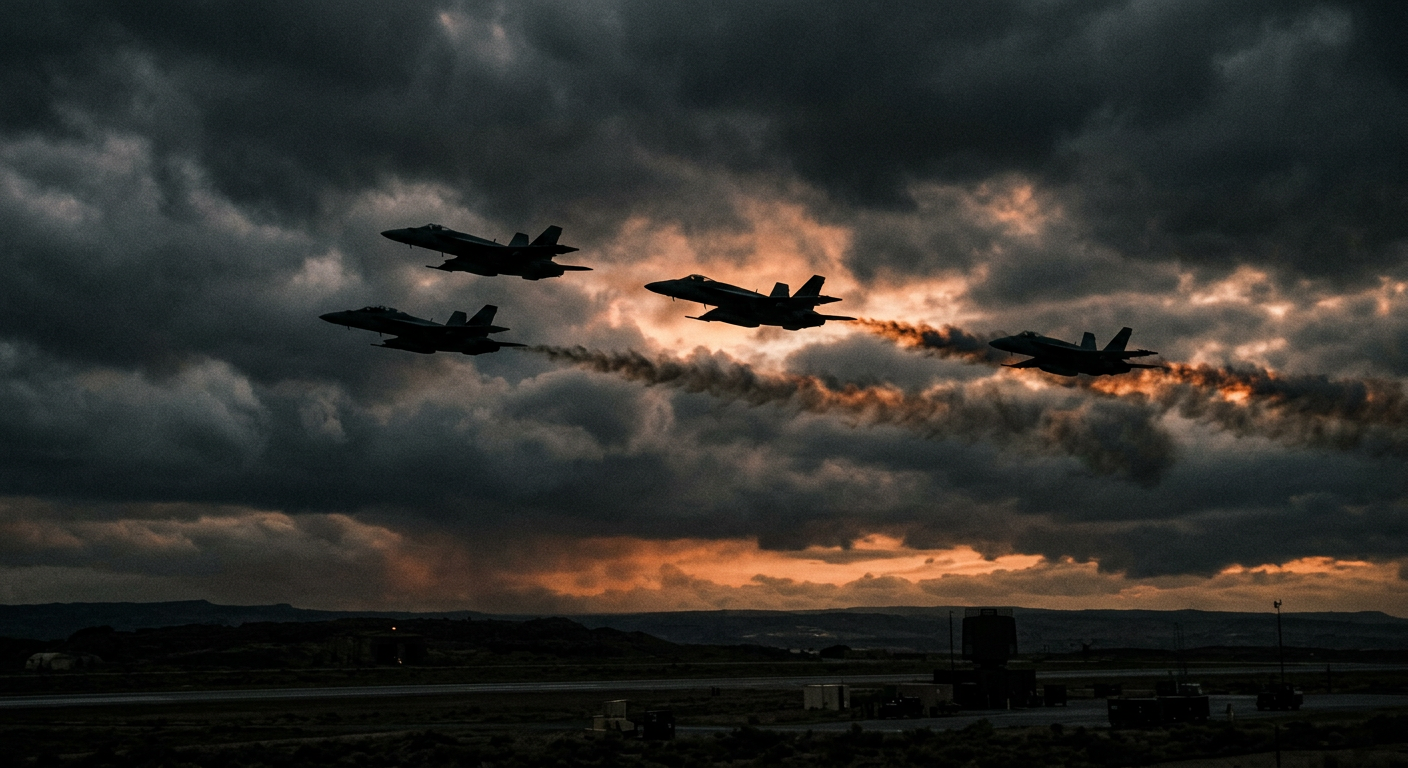
The president's remarks came hours after three US F-15 fighter jets were mistakenly shot down by Kuwaiti air defenses during a combat mission, according to US Central Command. All six crew members ejected safely in what military officials described as an apparent friendly fire incident, the Guardian reported. The episode underscored the chaotic nature of a conflict that has drawn multiple countries into direct combat in less than 72 hours.
Trump laid out four objectives for the campaign: stopping Iran's nuclear development, dismantling a ballistic missile program he claimed was "growing rapidly and dramatically," eliminating what he called a "colossal threat to America," and preventing missiles "capable of reaching our beautiful America" — a claim national security experts disputed. But the president immediately undercut the gravity of his war briefing by pivoting to boast about plans for a new White House ballroom, promising it would be the "most beautiful ballroom in the world" and come in "under budget" at "$400 million or less."
The tonal whiplash captured a deeper problem: Trump's stated rationale for the war didn't match the explanation his own secretary of state gave Congress the same day. Marco Rubio told lawmakers after a closed-door intelligence briefing that the US launched preemptive strikes because Israel was determined to attack Iran and American troops would inevitably be targeted in response — not because of an imminent threat to the United States itself.
That distinction alarmed even hawkish Democrats. "There was no imminent threat to the United States of America by the Iranians," said Mark Warner, the Democratic vice-chair of the Senate intelligence committee, according to the Guardian. "There was a threat to Israel. If we equate a threat to Israel as the equivalent of an imminent threat to the United States, then we are in uncharted territory."
Warner's warning gets at the constitutional heart of the matter: Trump launched a major war without congressional authorization based on threats to an ally, not the homeland. The Senate had already failed to block US involvement in the conflict, USA Today reported, but the administration's shifting explanations are fueling bipartisan unease about mission creep and legal authority.
The war's human toll is mounting rapidly. Iranian state media reported that more than 500 people have been killed since joint US-Israeli airstrikes began Saturday, including at least 165 people in an attack on a girls' school in southern Iran, according to the Guardian. The conflict has expanded dramatically across at least nine countries in under 10 hours on Monday alone, with casualties and destruction reported from Lebanon to Kuwait.
Israel launched fresh strikes into Lebanon after Hezbollah retaliated for Saturday's Israeli attack that killed Iran's supreme leader, Ayatollah Ali Khamenei. Israeli and US warplanes continued bombing runs across Iran throughout Monday. The Iranian Red Crescent Society struggled to reach victims as infrastructure collapsed. Oil markets reacted predictably: USA Today reported Americans are fretting over soaring gas prices as Iran closed a key waterway, raising questions about who controls critical shipping lanes.
The Pentagon has insisted there are no US ground troops in Iran, but the friendly fire incident over Kuwait suggests American forces are operating in a congested, high-risk environment where even allies can't distinguish friend from foe. The fact that Kuwait — a longstanding US partner that hosts American military bases — shot down three advanced American fighters during a combat mission reveals dangerous coordination failures.
Trump also took time Monday to complain that the UK "took far too long" to allow US forces to use British airbases for strikes on Iran, telling reporters he was "very disappointed" in Prime Minister Keir Starmer. The public rebuke of America's closest military ally, delivered while US jets were being shot down by another partner nation, illustrated the diplomatic strains of a hastily launched war.
The president's ballroom digression wasn't his only odd moment. He appeared at a Medal of Honor ceremony with a visible neck rash, which the White House later attributed to "preventative" skin treatment, according to the Guardian. The episode added to ongoing speculation about Trump's health as he manages what could become the longest US military engagement in the Middle East since the Iraq War.
Meanwhile, his wife Melania Trump became the first spouse of a sitting world leader to preside over the UN Security Council on Monday, calling for protection of children's access to education — a message that landed awkwardly as reports emerged of the deadly strike on the Iranian girls' school. The symbolic disconnect between the first lady's UN remarks and the administration's military actions captured the tonal incoherence of a war launched without clear strategy or endgame.
Trump claimed other countries backed US efforts to stop Iran's nuclear program but "they just didn't have the courage to say so." That assertion, offered without evidence, sits uneasily with the UK's reported reluctance and the absence of public support from traditional Middle Eastern allies. If the war does stretch for months as Trump now suggests, he'll need more than secret supporters — he'll need a coalition willing to share the costs of a conflict that's already proving deadlier and more complex than the four-to-five-week timeline anyone initially imagined.
The Senate's failure to block US involvement means Trump has a free hand for now. But with American pilots dodging allied fire, gas prices climbing, and no clear exit strategy beyond vague goals about missiles and nukes, the political pressure will build. Warner's warning about "uncharted territory" may prove prescient: Trump has effectively committed the US to fight Israel's wars as if they were America's own, with no congressional debate and no plan for what happens when four weeks turns into four months.