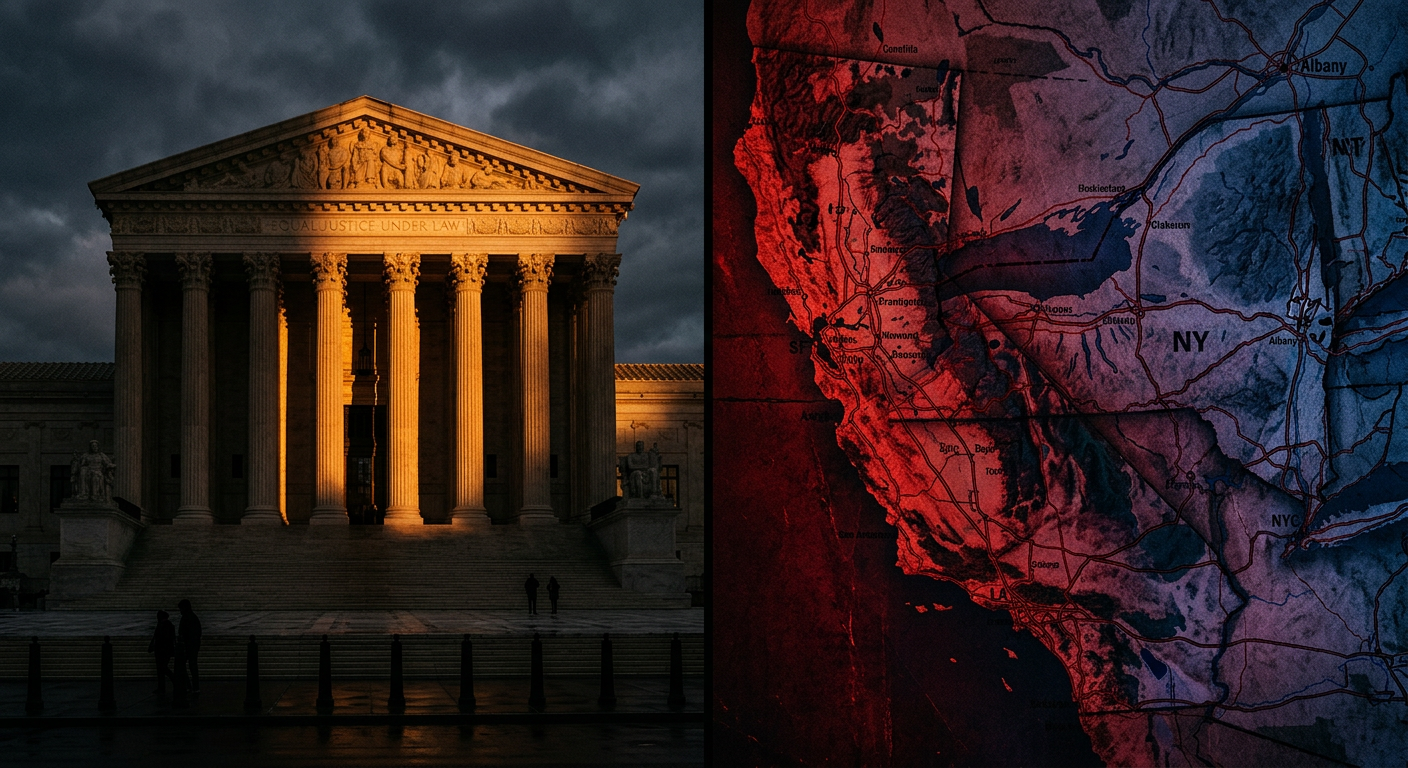
Supreme Court Halts Two State Election Rules in 24 Hours as Conservatives Flex Power Over 2026 Midterms
In a striking display of judicial muscle, the Supreme Court's conservative majority issued back-to-back rulings blocking California's transgender notification policy and freezing New York's congressional redistricting—both over furious liberal dissents warning of federal overreach into state matters.
The Supreme Court's conservative supermajority delivered a one-two punch to Democratic-led states Monday and early Tuesday, blocking California's restrictions on parental notification about transgender students and halting a court order to redraw New York's sole Republican congressional district. The rulings, both decided 6-3 along ideological lines, signal an increasingly aggressive posture by the court's conservatives on hot-button cultural and electoral issues heading into the 2026 midterms.
In the California case, the court ruled that state policies restricting when schools can notify parents about students who come out as transgender—and requiring teachers to use children's preferred pronouns—likely violate both the First Amendment's free exercise clause and parents' constitutional rights under the 14th Amendment. "The parents who assert a free exercise claim have sincere religious beliefs about sex and gender, and they feel a religious obligation to raise their children in accordance with those beliefs," the court wrote in an unsigned opinion, according to NBC News.
The Thomas More Society, the conservative legal group representing the parents, called it "the most significant parental rights ruling in a generation." Paul Jonna, one of the group's attorneys, declared the decision "told California and every state in the nation in no uncertain terms: you cannot secretly transition a child behind a parent's back."
But Justice Elena Kagan's dissent exposed a glaring contradiction at the heart of the ruling. She noted the court's embrace of 14th Amendment parental rights claims stands in awkward tension with its 2022 decision overturning Roe v. Wade—which rejected similar substantive due process arguments about fundamental rights not explicitly spelled out in the Constitution. The new ruling "cannot but induce a strong sense of whiplash," Kagan wrote, pointing out that the court recently refused to even hear parental rights claims from parents seeking gender-affirming care for their children when it upheld state bans on such treatments last year. "In that case, the Court would not even hear the parents out on their substantive due process claim," she observed.
California Attorney General Rob Bonta's office said it was "disappointed" but remained "committed to ensuring a safe, welcoming school environment for all students while respecting the crucial role parents play in students' lives." The state had argued its policies allow schools to balance parental interests with students' particular needs, including the risk of harm upon disclosure without student consent.
Hours later, the court waded into New York's redistricting battle, freezing a state trial judge's order that would have required redrawing the 11th Congressional District—which includes Staten Island and parts of southern Brooklyn—to add Black and Latino voters who make up roughly 30% of Staten Island's population. The ruling allows Rep. Nicole Malliotakis, New York City's only Republican House member, to run in 2026 using the existing map, according to SCOTUSblog.
Justice Samuel Alito, writing separately, called the lower court's order "unadorned racial discrimination" and argued that "a state law cannot authorize the violation of federal rights." He justified the Supreme Court's intervention by claiming there was "an unacceptably strong possibility" the state appeals process wouldn't conclude in time for the justices to review the case—despite the general election being eight months away.
Justice Sonia Sotomayor wasn't buying it. In a blistering dissent joined by Kagan and Justice Ketanji Brown Jackson, she accused her colleagues of executing an "unexplained about-face" from the court's normal practice of staying out of state election litigation. "The Court's 101-word unexplained order can be summarized in just 7: 'Rules for thee, but not for me,'" Sotomayor wrote. "Time and again, this Court has said that federal courts should not meddle with state election laws ahead of an election... Ignoring every limit on federal courts' authority, the Court takes the unprecedented step of staying a state trial court's decision in a redistricting dispute on matters of state law without giving the State's highest court a chance to act."
Sotomayor dismissed warnings of impending "chaos" as "illusory," noting that "the general election is eight months away and the primary is about four months away. That is more than enough time" for New York's courts to resolve the matter. She warned the ruling "thrusts itself into the middle of every election-law dispute around the country, even as many States redraw their congressional maps ahead of the 2026 election. It also invites parties searching for a sympathetic ear to file emergency applications directly with this Court, without even bothering to ask the state courts first."
Malliotakis celebrated the decision, saying "the plaintiffs in this case attempted to manipulate our state's courts to use race as a weapon to rig our elections," according to CBS News. The dispute is part of a broader redistricting war triggered by President Trump's urging of Texas Republicans to redraw congressional districts for political gain, which Democrats countered with their own aggressive gerrymandering in California.
The back-to-back rulings reveal a Supreme Court increasingly willing to use its emergency docket—the so-called "shadow docket"—to reshape state policies and election rules without full briefing or oral argument. The California decision embraces parental rights arguments the court has selectively rejected when they cut against conservative positions. The New York ruling intervenes in state court proceedings before they've even reached the state's highest court, a departure from traditional federalism principles conservatives typically champion.
What's particularly striking is the speed and confidence with which the conservative majority is moving. Both rulings arrived within 24 hours, both overrode state court decisions, and both did so over passionate dissents warning of institutional damage. The message to state courts and legislatures in blue states is unmistakable: the Supreme Court's conservative supermajority will not hesitate to override your decisions when they conflict with the right's priorities on culture war issues and electoral advantage.
For Democrats, these rulings compound a sense of helplessness as the 2026 midterms approach. California's ability to protect LGBTQ students from forced outing has been curtailed. New York's attempt to address racial vote dilution has been frozen. And the Supreme Court has signaled it will continue using emergency orders to reshape election rules in real time, despite its own stated principles about judicial restraint near elections.
The court's liberals are clearly alarmed. Kagan's "whiplash" comment and Sotomayor's "rules for thee" rebuke suggest they see the conservative majority as outcome-driven rather than principled. When parental rights support conservative positions on transgender issues, they're sacrosanct 14th Amendment claims. When they support liberal positions on gender-affirming care, they're not even worth hearing. When federal courts shouldn't meddle in state elections, that principle evaporates the moment a Republican-held seat is at stake.
The immediate political impact is clear: Malliotakis gets to defend her seat on favorable terrain, and California parents who object to LGBTQ-inclusive policies have won a significant legal victory. The longer-term impact may be even more consequential. The Supreme Court has demonstrated it will actively manage election rules and culture war disputes through emergency orders, traditional federalism be damned. And with the 2026 midterms approaching and control of the narrowly divided House hanging in the balance, expect more midnight interventions from a conservative majority that has decided restraint is for other courts.